

Most men still see resistance bands as rehab tools or warm-up gear. That belief keeps a lot of people from using one of the most effective training tools available.
Resistance band exercises for men can build muscle, strength, and conditioning without heavy equipment. Bands create increasing tension as you move, which forces muscles to work harder at the strongest part of each rep.
They also demand more control and stability than machines, making them ideal for real-world strength and athletic movement. With proper setup, bands can train the entire body using push, pull, leg, and core patterns.
This article explains why bands work, how to use them safely, the best exercises by muscle group, and how to program them for consistent results.
Resistance Band Exercises for Men: 6 Proven Benefits
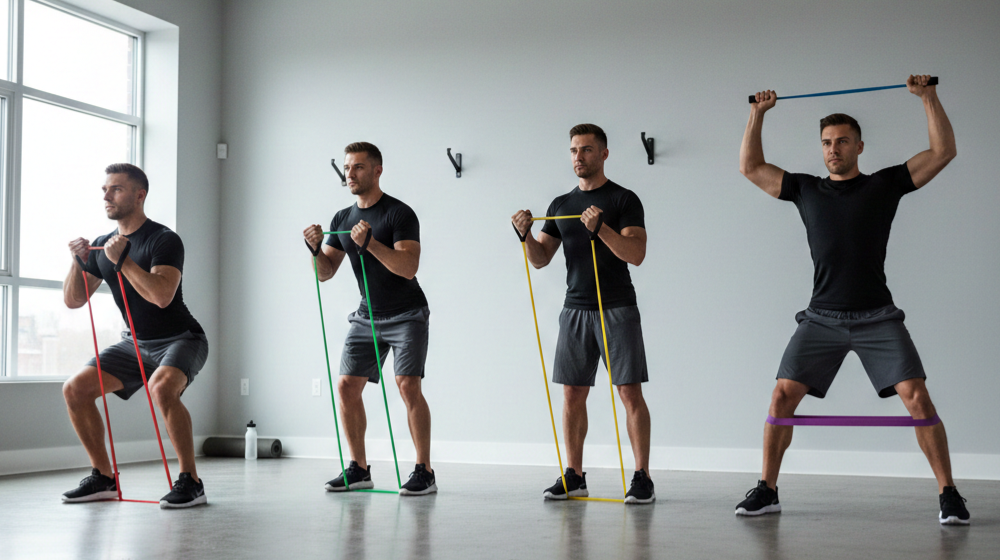
Resistance bands apply variable tension instead of fixed weight. This changes how muscles are challenged throughout each movement.
That difference delivers several key advantages:
- More tension at peak contraction, where muscles are strongest
- Greater stability demands, which improve coordination and joint control
- Easy resistance scaling using band thickness or distance from the anchor
- Portable training that works at home, outdoors, or while traveling
For men focused on strength or physique goals, bands provide a serious training stimulus when used with intent.
Equipment Needed for Band Training
Band training stays effective because the setup is simple. You do not need machines, racks, or plates.
The most useful band options include:
- Loop bands for squats, lunges, and lateral movement
- Handle bands for presses, rows, and arm work
- An optional anchor, such as a door attachment or sturdy fixed object
Follow these setup rules every session:
- Increase difficulty with thicker bands or stepping farther away
- Secure the anchor before loading tension
- Never let go of a band while stretched
- Check bands for wear, cracks, or thinning before use
Chest Exercises Using Resistance Bands

Chest training with bands focuses on pressing and fly patterns that keep constant tension on the muscles.
Effective chest movements include:
- Banded push-ups to increase load at lockout
- Banded chest press performed on the floor for shoulder safety
- Banded chest fly using either a floor or anchored setup
Control the tempo and focus on squeezing the chest at the top of each rep.
Back Training With Band Pull Movements
Pulling exercises with bands develop the upper back, lats, and postural muscles.
Strong back options include:
- Standing bent-over rows by standing on the band
- Anchored row variations pulling from low, mid, or high positions
Changing the angle shifts emphasis across different areas of the back.
Shoulder Training With Bands
Bands work well for shoulder isolation and control. They encourage smoother movement and joint stability.
Key shoulder exercises include:
- Lateral raises for the side delts
- Front raises for anterior shoulder strength
- Angled presses from an anchor to adjust loading
Use slow, controlled reps and avoid momentum.
Arm Exercises for Biceps and Triceps
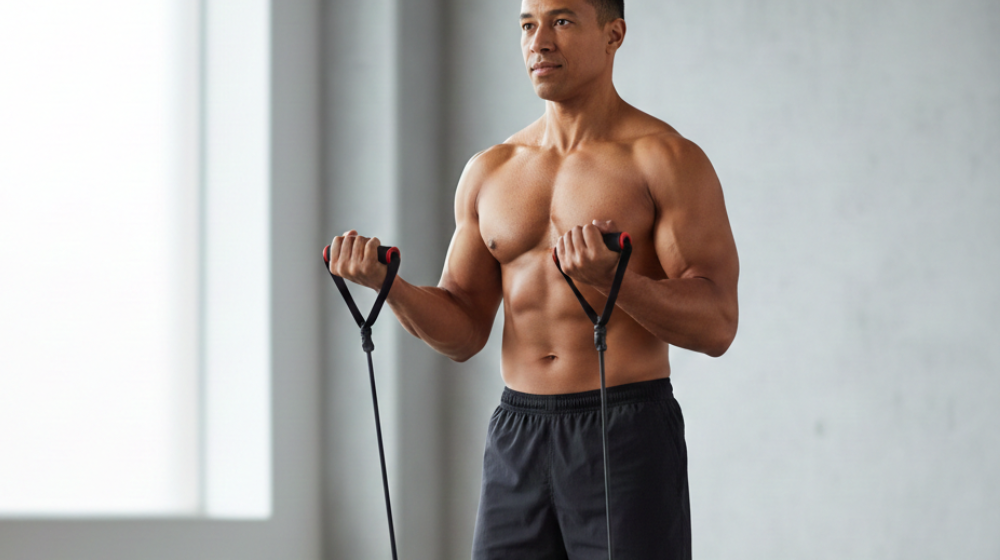
Band resistance keeps constant tension on the arms without stressing the joints.
Effective arm movements include:
- Standing biceps curls while standing on the band
- Triceps extensions using overhead or kickback-style patterns
Pausing briefly at peak contraction increases effectiveness.
Leg Training With Resistance Bands
Lower-body band training challenges strength, balance, and coordination.
Productive leg exercises include:
- Squat to shoulder press for total-body strength
- Side step with squat using a loop band around the thighs
- Lunge-based combinations that pair leg drive with upper pulling
Maintain tension throughout each rep and avoid rushing transitions.
Core Training Using Band Resistance

Core exercises with bands focus on resisting movement, not just creating it.
Core-focused options include:
- Single-arm presses or rows to create anti-rotation demand
- Anchored twists and woodchop patterns for rotational strength
Keep the torso stable and move with control.
Full-Body Resistance Band Program Structure
A full-body program works well for most men using bands as their primary resistance.
A simple framework includes:
- Training frequency: 2 to 3 sessions per week
- Rep range: Mostly 8 to 15 reps per exercise
- Structure: Circuit format with minimal rest
Begin with one round and progress to multiple rounds as strength improves.
Split Training Options With Bands
Split routines allow more focus per session and can support higher training volume.
Common band-based splits include:
- Push pull legs
- Push: chest, shoulders, triceps
- Pull: back, biceps
- Legs and core: squat, hinge, lunge, anti-rotation
- Upper lower split
- Upper: presses, rows, raises, curls, extensions
- Lower: squats, lunges, hinges, glute stability work
Choose the split that fits recovery and schedule.
How to Progress Resistance Band Exercises
Progression keeps band training effective long term.
Increase difficulty by:
- Moving to thicker bands
- Stepping farther from the anchor
- Slowing the lowering phase
- Adding sets or circuit rounds
Always maintain control and avoid overstretching bands beyond their limits.
Conclusion
Resistance band exercises for men provide a complete, scalable training system that builds muscle, strength, and conditioning with minimal equipment. When programmed correctly, bands are not a compromise but a reliable tool for long-term progress at home, on the road, or alongside gym training.