
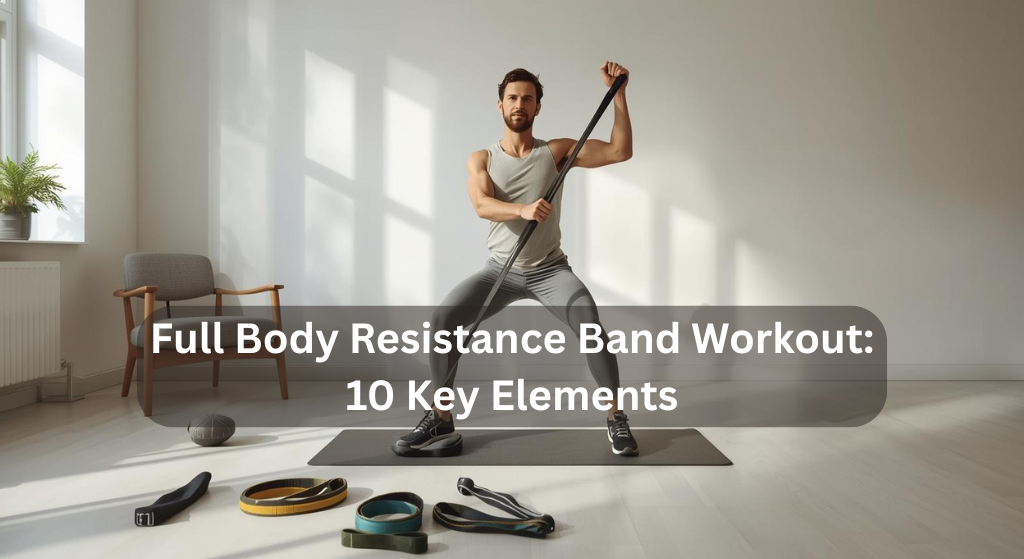
Resistance bands look simple, but they can deliver a serious full-body workout when used the right way. They are easy to store, gentle on joints, and strong enough to challenge beginners and advanced lifters alike.
A full-body resistance band workout is a training approach that uses elastic resistance to target every major muscle group in one session.
Instead of relying on gravity like free weights, bands create constant tension through the full range of motion, which helps improve strength, muscle control, and coordination.
This style of training is joint-friendly, easy to scale for all fitness levels, and effective for building muscle, improving endurance, and supporting long-term consistency. When structured correctly, it can fully replace or enhance traditional gym workouts.
This guide breaks down how resistance bands work, how to set them up safely, and how to build full-body workouts that actually get results.
Full Body Resistance Band Workout: 10 Key Elements

Resistance bands work differently from dumbbells or machines. As the band stretches, the tension increases, which keeps your muscles working from start to finish.
This training style offers several advantages:
- Constant tension that does not disappear at the top or bottom of a move
- Joint-friendly resistance that feels smoother than heavy weights
- Natural strength matching since tension rises as you get stronger in the movement
- Easy portability for home or travel workouts
- Multi-directional training that supports real-life movement patterns
Equipment Selection and Setup
Choosing the right bands makes your workouts safer and more effective. Different band styles serve different purposes.
Common options include:
- Loop bands for squats, deadlifts, and assisted pulls
- Tube bands with handles for presses, rows, and door-anchored work
- Mini bands for glutes, shoulders, and smaller muscle groups
For most people, having three to four resistance levels works well. Light bands suit warm-ups and smaller muscles, while heavier bands handle legs and compound lifts.
Before every session:
- Check bands for cracks or thinning
- Make sure door anchors are secure
- Never stretch bands more than about twice their original length
- Never let go of a band under tension
Pre-Workout Preparation
A short warm-up prepares your joints and muscles for resistance work. It also lowers the risk of strain.
Keep preparation simple:
- 3 to 5 minutes of light cardio or dynamic movement
- A quick equipment check and clear workout space
- Comfortable footwear with stable footing
Focus on learning proper form first. Intensity can always increase later.
Movement Pattern Framework
The most effective full-body workouts are built around movement patterns, not individual muscles. This approach trains the body to work as a unit.
Squat Pattern
Squat movements train the lower body while engaging the core for stability.
Common benefits include stronger legs and improved daily movement.
Typical exercises:
- Banded front squat
- Sumo squat
- Squat to press
- Split squat variations
Aim for 12 to 15 controlled reps per set with steady tension.
Hinge Pattern
Hinge movements focus on the back side of the body, especially glutes and hamstrings.
These exercises protect your lower back when done correctly.
Effective options include:
- Romanian deadlifts
- Single-leg deadlifts
- Good mornings
Work in the 10 to 15 rep range with slow, controlled motion.
Push Pattern
Push exercises develop the chest, shoulders, and triceps.
They can be done standing, seated, or on the floor depending on space and strength.
Examples include:
- Chest presses
- Overhead presses
- Push-up variations
Keep reps between 10 and 15 with short rest periods.
Pull Pattern
Pulling movements strengthen the back and support good posture.
They balance pushing work and reduce shoulder strain.
Effective pulls include:
- Bent-over rows
- Lat pulldowns
- Upright rows
Target 8 to 15 reps with a focus on squeezing the back muscles.
Core and Isolation Work
Core training supports every other movement in your workout.
Include a mix of stability and controlled motion:
- Planks and dead bugs
- Pallof presses
- Rotational twists
- Controlled crunch variations
Most core work fits well in the 12 to 20 rep range.
Programming Structure and Variables

How you organize your workout matters as much as the exercises you choose.
Key programming principles:
- Strength focus uses lower reps with heavier bands
- Muscle building works best in moderate rep ranges
- Endurance training uses lighter resistance and higher reps
For most people:
- Three full-body sessions per week work best
- Allow 48 to 72 hours between sessions
- Use effort as your guide rather than chasing exact numbers
You should finish most sets feeling like you could do about two more reps with good form.
Form Cues and Safety Guidelines
Good technique keeps workouts effective and pain-free.
General form reminders:
- Maintain a neutral spine
- Brace your core before each rep
- Move slowly with control
- Avoid locking joints at the top
- Breathe out during effort
Lower body safety:
- Knees track over toes
- Weight stays balanced through the feet
- No excessive rounding or arching
Upper body safety:
- Keep shoulders down and relaxed
- Avoid forcing arms too high
- Maintain neutral wrist position
Band safety always comes first. Inspect equipment and respect tension limits every time.
Sample Full Body Routines
This workout builds confidence and teaches form.
- Banded squat
- Bent-over row
- Chest press
- Squat to shoulder press
- Reverse lunge with curl
- Lat pulldown
- Push-up variation
- Core twists
Keep sessions around 25 minutes with steady pacing.
Intermediate Routine
This format increases intensity using circuits.
- Lower body compound movements
- Upper body push and pull pairings
- Core stability drills
Work in short intervals with limited rest for a combined strength and cardio effect.
Advanced Routine
Advanced programs increase volume and challenge balance.
- Single-leg lower body work
- Heavy band compound presses
- Extended core sequences
Sessions last longer and focus on muscle growth and strength progression.
Progressive Overload Strategies
To keep improving, workouts must gradually become harder.
Simple progression methods include:
- Adding a few reps each week
- Shortening rest periods
- Increasing band resistance
- Slowing down the tempo
- Switching to more demanding exercise variations
Change only one or two variables at a time for steady progress.
Cool-Down and Recovery
Cooling down helps your body recover and prepares you for the next session.
After training:
- Walk lightly for a few minutes
- Stretch major muscle groups for 20 to 30 seconds
- Focus on breathing and relaxation
Between sessions, prioritize sleep, hydration, and regular movement on rest days.
Conclusion
A well-designed full-body resistance band workout proves that effective training does not require heavy equipment or a gym membership. By focusing on smart movement patterns, proper setup, safe technique, and gradual progression, resistance bands can help you build strength, improve fitness, and stay consistent no matter where you train. When used with intention and good form, they offer a simple yet powerful way to train your entire body and support long-term health and performance.