
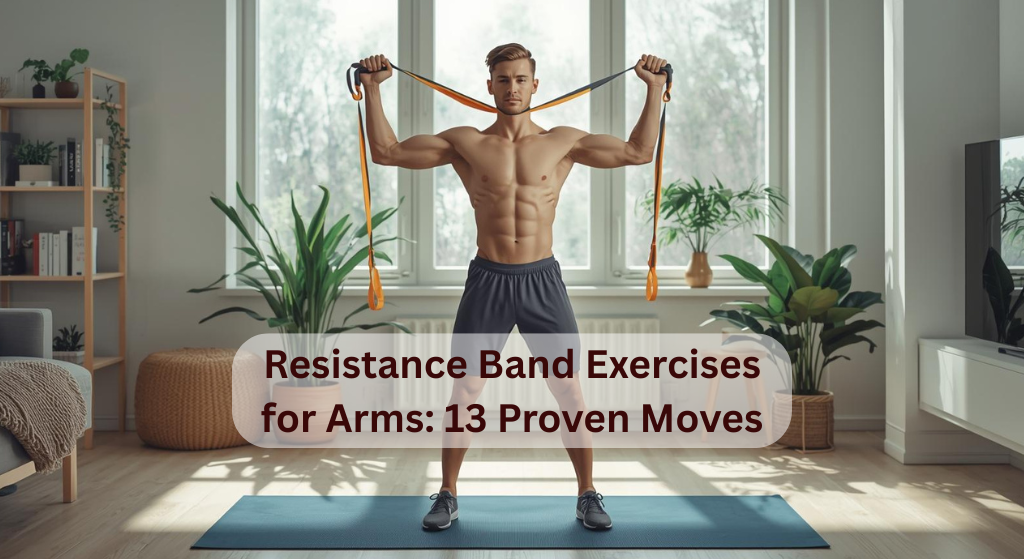
Strong arms are not built only in gyms with heavy weights. Many people want simple, effective ways to train their arms without stressing their joints or needing bulky equipment.
Resistance band exercises for arms offer a practical solution. Bands create steady tension that challenges muscles through the full range of motion.
This makes them effective for building strength, control, and muscle tone while staying gentle on the elbows and shoulders.
In this guide, you will learn how resistance bands work, which arm muscles they target, and how to perform the most effective band exercises for complete arm development.
Resistance Band Exercises for Arms: 13 Proven Moves

Resistance bands are flexible tools designed to provide tension as they stretch. Unlike weights, bands keep muscles engaged from start to finish, which improves muscle activation and control.
They work especially well for arm training because the resistance increases as you move. This allows for smooth, joint-friendly movements while still challenging the muscles.
Resistance band arm training targets:
- Upper arm muscles
- Forearm muscles
- Small stabilizing muscles that support joint health
Arm Muscles Worked with Resistance Bands
Resistance band exercises for arms activate multiple muscle groups at once. This balanced approach helps improve strength and coordination.
The main muscles involved include:
- Biceps, responsible for bending the elbow
- Triceps, which straighten the arm
- Forearms, supporting grip and wrist control
- Stabilizer muscles, helping with balance and joint support
Resistance Band Exercises for Biceps
Biceps respond well to resistance bands because the tension increases as the arm curls upward. This creates strong muscle engagement without heavy strain.
Standing Resistance Band Bicep Curl
This classic movement builds overall bicep strength using constant tension.
- Stand on the band with feet shoulder-width apart
- Hold handles with palms facing forward
- Curl hands toward shoulders while keeping elbows close
- Lower slowly to maintain control
Resistance Band Hammer Curl
This variation targets both the biceps and forearms.
- Hold the band with palms facing inward
- Curl hands upward while keeping wrists neutral
- Focus on squeezing the arms at the top
Single Arm Resistance Band Curl
Training one arm at a time improves balance and muscle control.
- Anchor one end of the band under your foot
- Curl with one arm while keeping the torso still
- Move slowly to avoid swinging
Resistance Band Concentration Curl
This exercise isolates the biceps for focused muscle work.
- Sit or stand with elbow braced against the thigh
- Curl the band upward with steady tension
- Lower the band slowly to maintain control
Resistance Band Exercises for Triceps
The triceps make up a large portion of the upper arm. Resistance bands allow smooth extension movements that reduce joint stress.
Resistance Band Tricep Pushdown
This exercise mimics cable machine pushdowns.
- Anchor the band overhead
- Keep elbows close to the sides
- Press hands downward until arms are straight
- Control the return movement
Overhead Resistance Band Tricep Extension
This movement emphasizes the long head of the triceps.
- Hold the band behind the head
- Extend arms upward while keeping elbows steady
- Engage the core for stability
Resistance Band Kickbacks
Kickbacks isolate the triceps effectively.
- Hinge slightly at the hips
- Keep upper arms still
- Extend forearms backward against the band
Close Grip Resistance Band Press
This exercise combines pressing strength with tricep focus.
- Hold the band at chest level
- Press forward while keeping hands close together
- Fully extend arms at the end of each rep
Resistance Band Exercises for Forearms
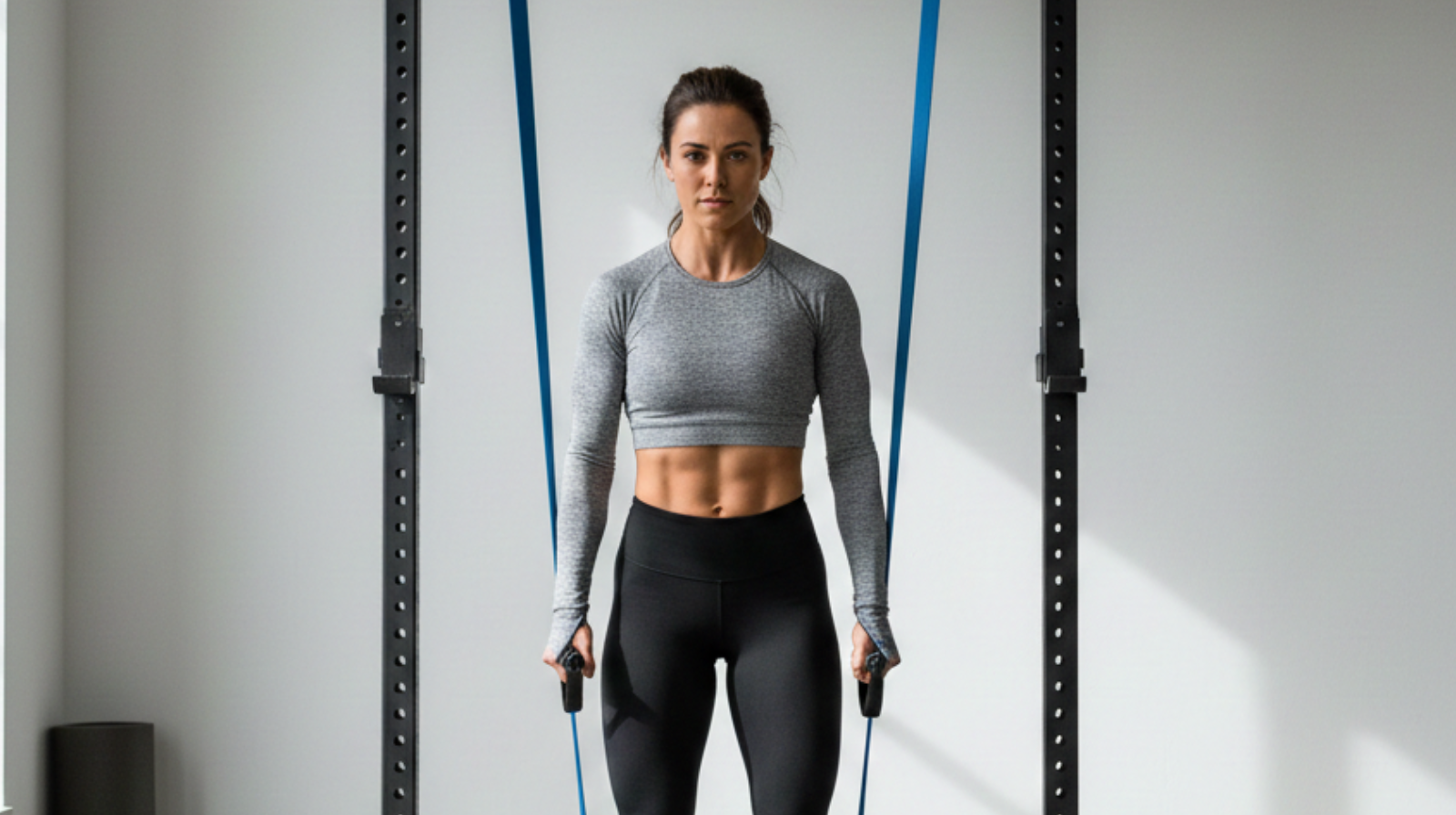
Forearm strength supports grip, wrist control, and overall arm stability. Bands provide controlled resistance for smaller muscles.
Resistance Band Wrist Curl
This movement targets wrist flexor muscles.
- Sit with forearms resting on thighs
- Hold the band with palms facing upward
- Curl wrists upward with control
Resistance Band Reverse Wrist Curl
This variation strengthens the wrist extensors.
- Hold the band with palms facing downward
- Lift hands upward slowly
- Focus on smooth movement
Resistance Band Grip Squeeze
Grip strength improves forearm endurance.
- Hold the band tightly in both hands
- Squeeze and hold for several seconds
- Release slowly to maintain tension
Full Arm Resistance Band Exercises
Compound movements engage multiple arm muscles at once, improving coordination and strength.
Resistance Band Upright Row
This exercise works the arms while supporting shoulder stability.
- Stand on the band with hands close together
- Pull the band upward to chest height
- Keep elbows slightly higher than hands
Resistance Band Curl to Press
This movement combines pulling and pressing actions.
- Perform a bicep curl
- Transition directly into an overhead press
- Maintain steady tension throughout the movement
Resistance Band Arm Workout Structure
A structured approach ensures balanced arm development and recovery.
For effective sessions:
- Start with larger muscle groups
- Perform 2 to 4 sets per exercise
- Aim for 10 to 15 controlled repetitions
- Rest 30 to 60 seconds between sets
Progression Techniques for Resistance Band Arm Exercises
Progression keeps muscles adapting and growing over time.
Effective methods include:
- Using thicker bands for higher resistance
- Slowing down each repetition
- Increasing total sets gradually
Common Mistakes During Resistance Band Arm Exercises
Avoiding common errors helps prevent injury and improves results.
Watch out for:
- Using momentum instead of muscle control
- Improper band anchoring
- Skipping the full range of motion
Safety Tips for Resistance Band Arm Training
Safe training ensures long-term progress and joint health.
Always remember to:
- Inspect bands for wear before use
- Maintain proper joint alignment
- Move through exercises with steady control
Conclusion
Resistance band exercises for arms provide a simple, effective way to build strength, improve control, and protect joint health. With the right techniques and consistent effort, bands can deliver impressive arm results without the need for heavy equipment.